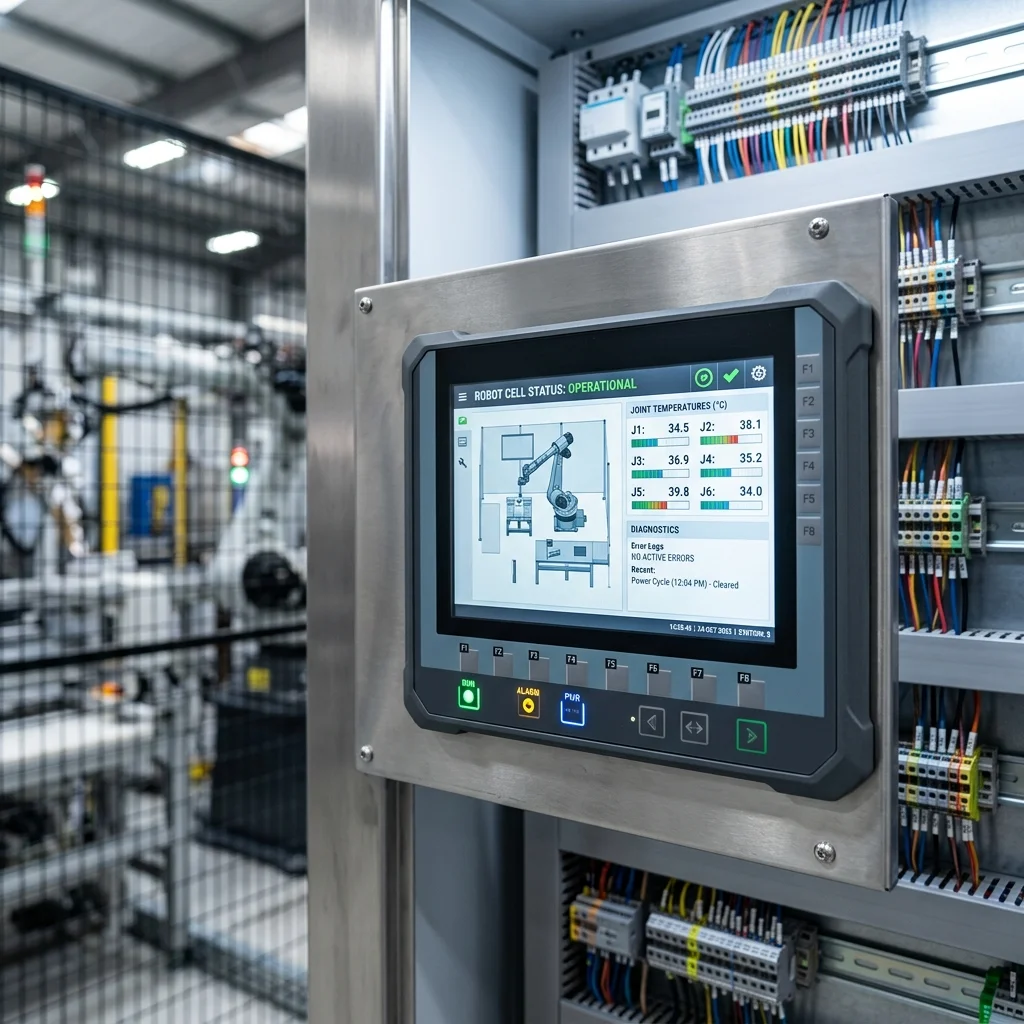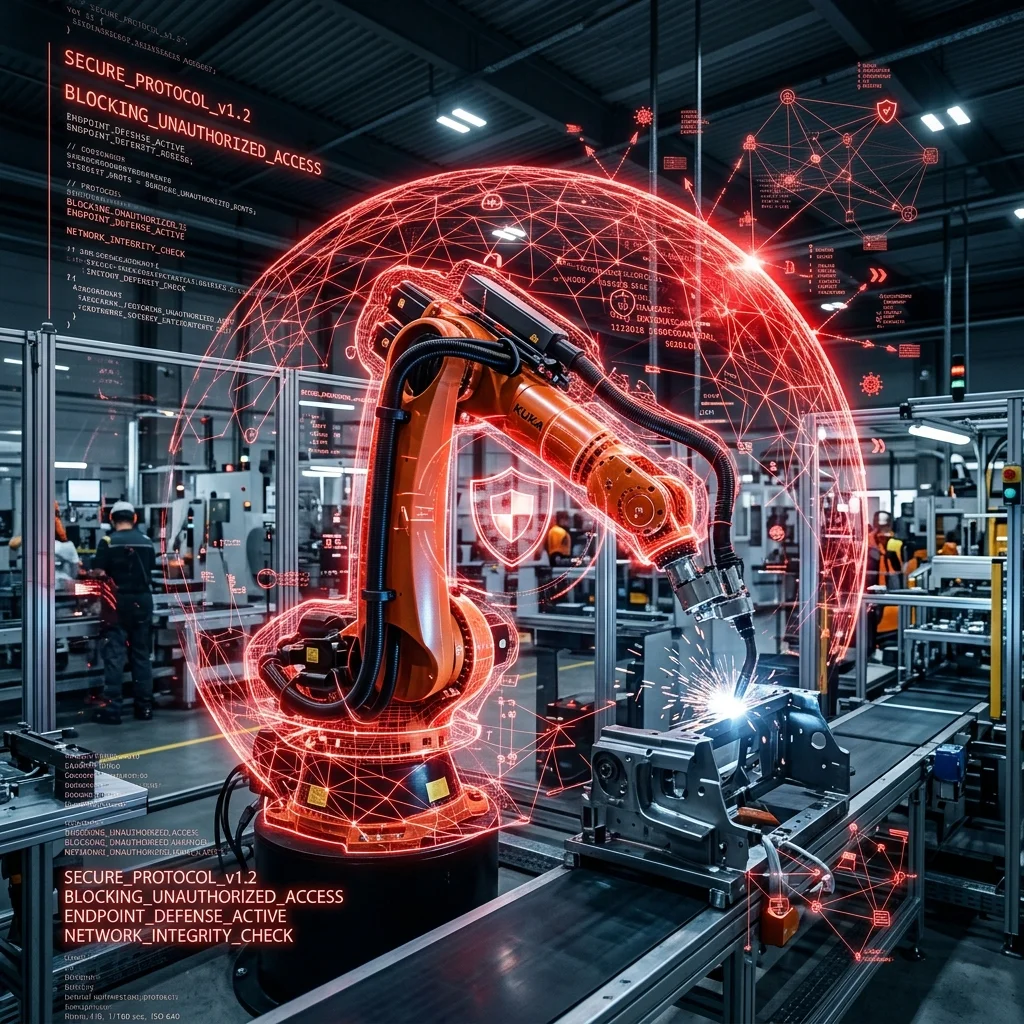
Securing connected industrial robotic cells requires implementing network segmentation between Operational Technology (OT) and Information Technology (IT) layers. Restricting remote access through virtual private networks (VPNs) with multi-factor authentication, disabling unused controller services, and running routine backup procedures are essential to prevent unauthorized access and protect production floors from cyber threats.
The Vulnerability of Connected Robotics in Industry 4.0
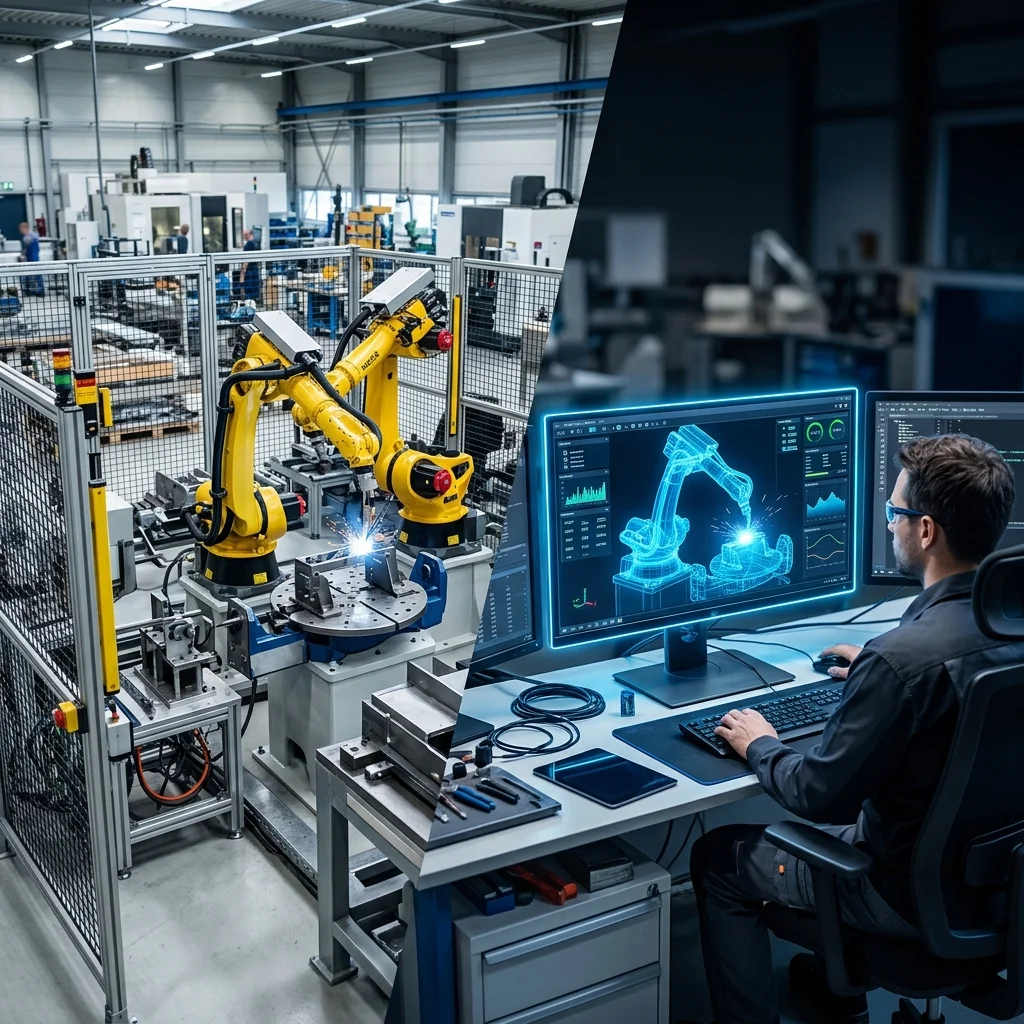
The transition to Industry 4.0 has connected once-isolated factory floors to corporate networks and cloud analytics platforms. While this connectivity enables real-time monitoring, predictive maintenance, and remote support, it also exposes industrial control systems (ICS) to cybersecurity risks. Industrial robots, which were designed for physical safety rather than network security, are vulnerable target points.
Many legacy robot controllers run on RTOS (Real-Time Operating Systems) that lack built-in security features like encryption, user authentication, or firewalls. If a hacker gains access to the factory network, they can potentially modify robot programs, change tool offsets, or override safety limits. These changes can cause physical damage to the robot, destroy workpieces, or cause severe injuries.
Cybersecurity in industrial robotics requires a shift from standard IT security to Operational Technology (OT) security. While IT focuses on data confidentiality, OT prioritizes system availability, reliability, and physical safety. Mitigating these risks requires a defense-in-depth strategy that protects every layer of the automation architecture, from network switches to the robot controller.
Network Segmentation: Isolating OT from IT Layers
The first line of defense is network segmentation. Robotic cells must be placed on a dedicated Operational Technology (OT) network that is physically or logically separated from the corporate Information Technology (IT) network. This prevents a security breach on an office PC (such as a phishing email) from spreading to the factory floor.
This separation is achieved by deploying industrial firewalls and managed switches to create a Demilitarized Zone (DMZ) between the IT and OT layers. The firewall should block all incoming traffic by default, allowing only specific protocols (such as OPC UA or Modbus TCP) to pass data between the PLC and the factory SCADA system. Corporate devices should never have direct access to robot controllers.
Furthermore, individual robotic cells should be isolated using micro-segmentation. By grouping the PLC, robot, and HMI of a specific cell into a private VLAN (Virtual Local Area Network), integrators can prevent a compromised device in one cell from communicating with or attacking other cells on the floor, limiting the blast radius of any security breach.
Securing the Robot Controller: Services and Authentication
Robot controllers are shipped with many network services enabled by default to simplify setup, including FTP servers, web servers, and telnet terminals. In a production environment, these unused services present open doorways for attackers. The integration team must disable all unused ports and protocols in the controller's configuration settings.
User authentication must be enforced. Many plants use generic or blank passwords for robot controllers, allowing anyone with network access to modify programs. Administrators should set up unique user profiles with different access levels (e.g., operator, maintenance, programmer), ensuring that only authorized personnel can load new files or change parameters. Strong password policies must be enforced.
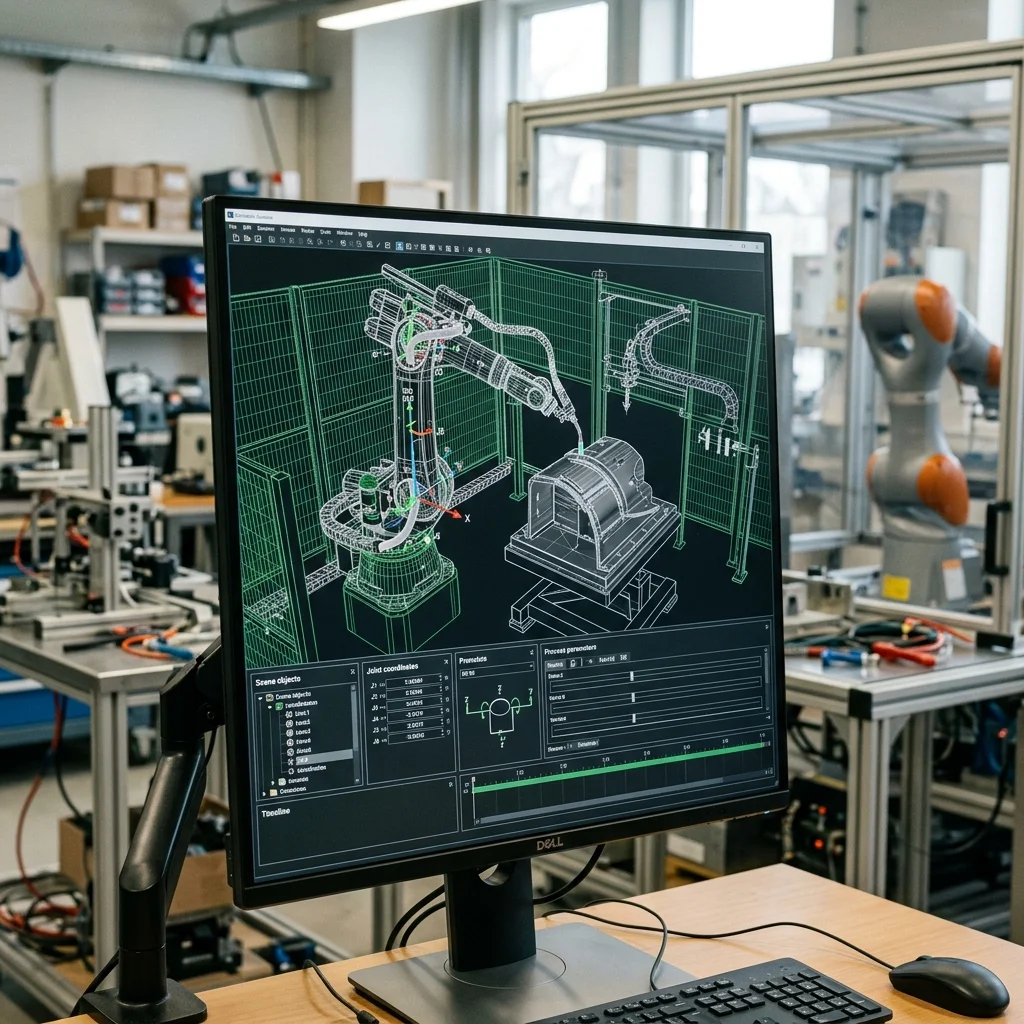
Firmware updates are also critical. Robot manufacturers periodically release software patches to fix security vulnerabilities in their operating systems. OT teams must establish a routine update schedule, verifying patches in a simulation environment before deploying them to production machines, ensuring the system remains protected against newly discovered exploits.
Secure Remote Access and Backup Protocols
Integrators and manufacturers often require remote access to troubleshoot code, update software, or monitor performance. To maintain security, this remote access must be routed through secure VPN (Virtual Private Network) gateways equipped with multi-factor authentication (MFA). Direct remote connections to the robot controller must be prohibited.
OT teams should implement 'on-demand' remote access. The VPN gateway should be physically switched off by local operators, and activated only when remote support is needed. Once the session is complete, the gateway is powered down. This prevents remote access routes from remaining active in the background, where they could be discovered by scanners.
Finally, robust backup procedures are essential for disaster recovery. In the event of a ransomware attack or corruption, the OT team must be able to restore the cell to its last known good state. Robot programs, PLC logic, and HMI configurations should be backed up automatically to an offline, immutable storage device, ensuring that production can resume quickly without paying a ransom.
Robotics Cybersecurity Implementation Checklist
Before signing off on a connected robotic cell, the cybersecurity and OT teams must run through a security checklist. First, verify that the robot controller is placed behind an industrial firewall on a segmented OT VLAN. Second, audit the controller settings to ensure all unused network ports (such as FTP or Telnet) are disabled.
Third, change all default OEM passwords and set up role-based user access profiles. Fourth, verify that the remote access VPN gateway requires multi-factor authentication and is configured for manual activation. Finally, test the backup restoration procedure, confirming that the cell can be fully restored from offline backups within target recovery times.