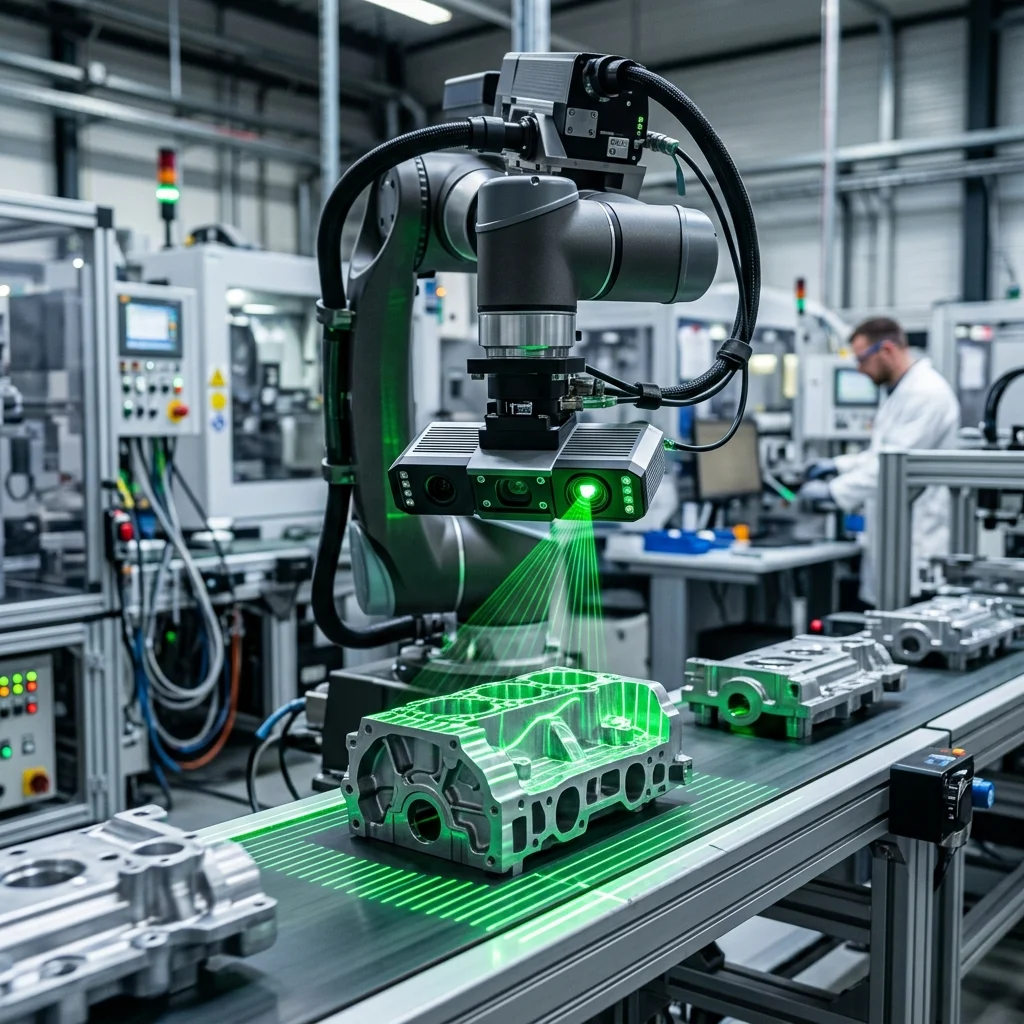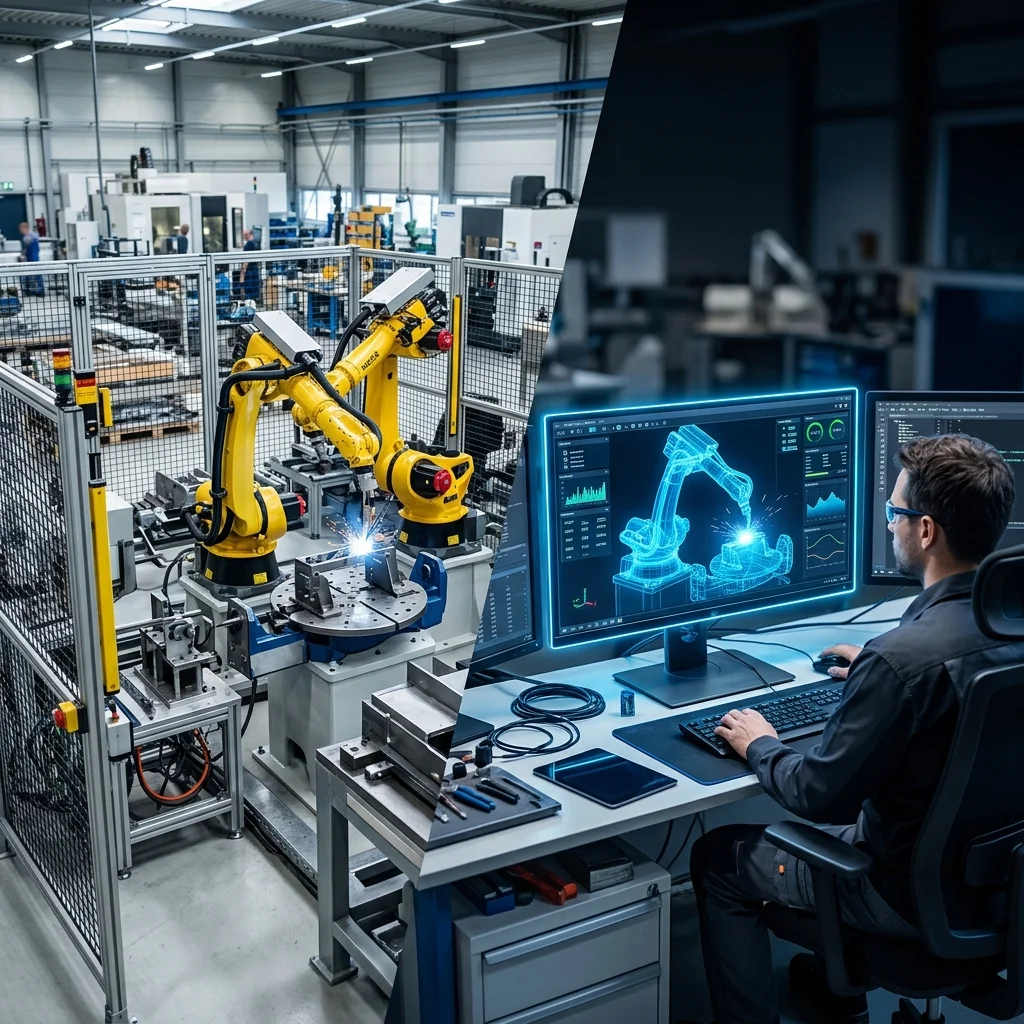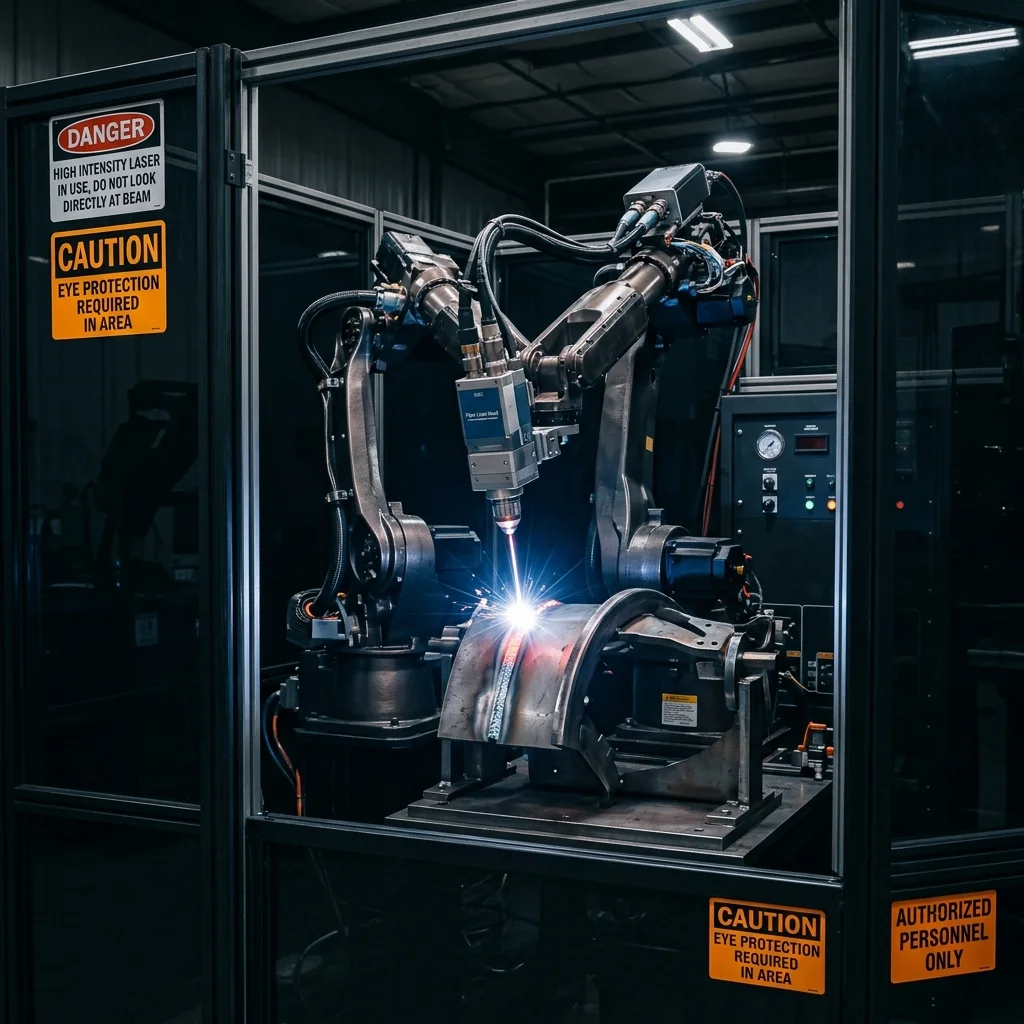
Robotic laser welding offers high process speeds and minimal heat deformation, but it requires tight tolerances, often below 0.1 mm. To achieve this precision, automated cells integrate real-time optical seam tracking sensors that use laser triangulation to measure path deviations, allowing the robot to adjust its welding trajectory dynamically during the process.
The Precision Challenge in Robotic Laser Welding
Laser welding is a widely used process in automotive and aerospace manufacturing because it creates deep, narrow welds at high speeds. Unlike traditional arc welding, which uses a filler wire, laser welding relies on a focused beam of light to melt the base metals. This concentrated energy source reduces heat-affected zones and limits distortion, which is critical for thin-walled assemblies.
However, the small spot size of the laser (often under 0.3 mm) means that beam alignment must be precise. If the joint fit-up varies by even 0.1 mm, the laser beam can miss the seam, resulting in a failed weld. Standard industrial robots lack the absolute accuracy required to maintain this alignment without external sensor guidance.
To deploy laser welding successfully, mechatronics engineers must integrate real-time tracking systems. These sensors inspect the joint geometry just ahead of the weld pool, calculating path corrections and sending them to the robot's motion controller. This sensor integration allows the system to adapt to part variations and thermal distortion during the cycle.
Optical Seam Tracking and Laser Triangulation
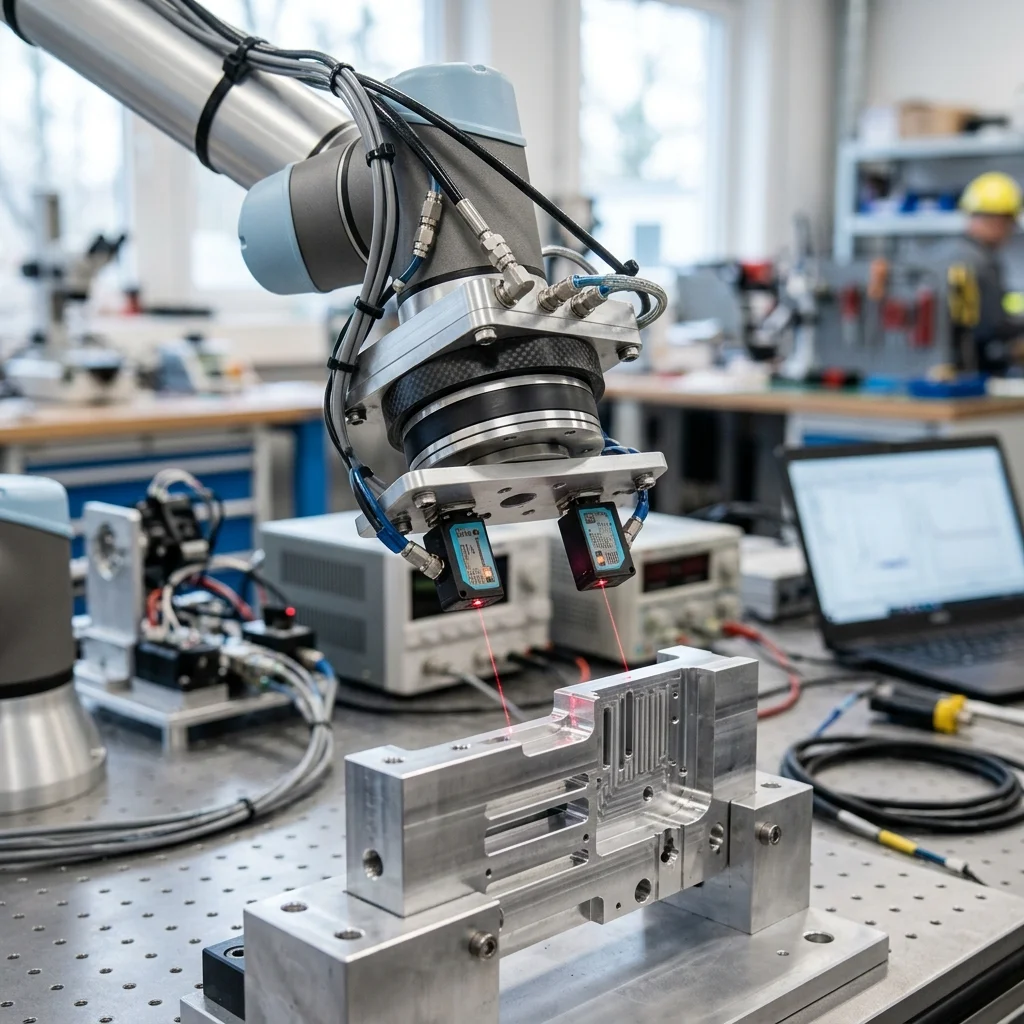
Optical seam tracking sensors are mounted just ahead of the laser welding head. The sensor projects a laser line across the weld joint, and an integrated camera captures the reflection. By analyzing the shape of the reflected line (using laser triangulation principles), the sensor's software calculates the joint's position, gap width, and alignment angles.
These measurements are sent to the robot controller over a high-speed link (such as EtherCAT or UDP packets) at frequencies up to 100 Hz. The robot's control loop reads these offset coordinates and adjusts the path of the tool flange dynamically. This real-time tracking compensates for part positioning errors and thermal expansion during welding.
Seam tracking software must filter out optical noise generated by the weld pool. The intense light, spatter, and fumes from the weld can interfere with the sensor's camera. Modern tracking systems use narrow-band optical filters that match the sensor's laser wavelength, blocking out the light from the weld arc to ensure clean measurements.
Laser Beam Alignment and Tool Center Point (TCP) Calibration
Maintaining accurate Tool Center Point (TCP) calibration is critical for laser welding. The TCP represents the focal point of the laser beam in the robot's coordinate system. If the TCP is off by even a fraction of a millimeter, the path calculation will be inaccurate, leading to weld defects.
TCP calibration is performed using automated laser alignment systems. The robot moves the welding head through a series of angles, passing the laser beam through a cross-beam sensor. The sensor measures the position of the focal point, and the controller updates the TCP coordinates automatically. This calibration should be scheduled daily or after any nozzle cleaning cycle.
In addition to mechanical alignment, beam quality must be monitored. Over time, protective glass covers can become contaminated with spatter, which distorts the laser beam and reduces energy density. Integrating cover glass monitoring sensors helps to prevent weld quality decay by alerting operators when the glass needs replacement.
Heat Input Control and Path Velocity Integration
The quality of a laser weld depends on maintaining a consistent heat input per unit length. This requires coordinating the laser power output with the robot's path velocity. If the robot slows down to navigate a tight corner while the laser power remains constant, the heat input will spike, causing burn-through.
To prevent this, modern systems use analog interface links between the robot controller and the laser source. The robot controller scales the laser power output dynamically based on its actual TCP speed. As the robot accelerates or decelerates, the laser power matches the speed profile, ensuring uniform heat distribution.
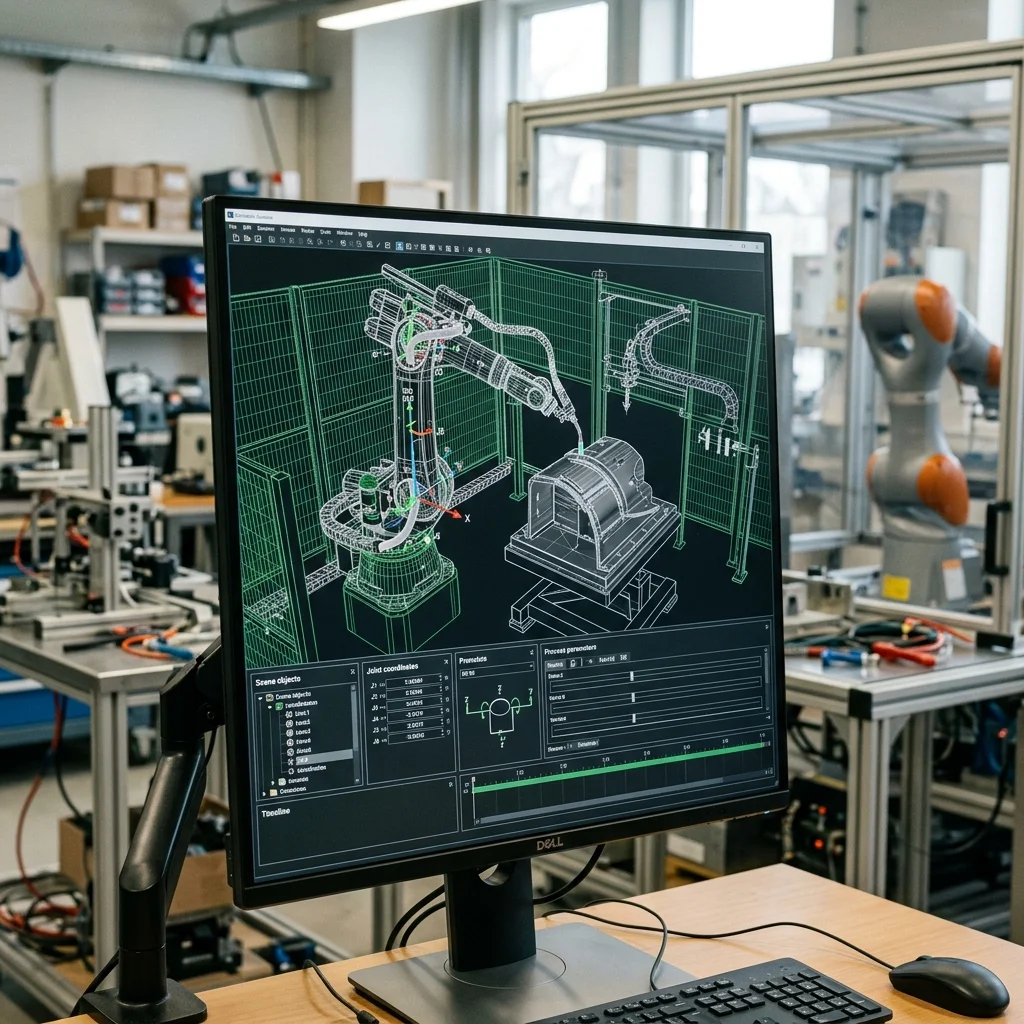
Offline programming (OLP) tools should be used to simulate velocity profiles during the design phase. By analyzing the joint path, the software can identify areas where the robot must slow down due to axis limits, allowing programmers to adjust the path or adjust the laser power in advance to maintain consistent weld quality.
Laser Welding Cell Setup and Verification Checklist
Before starting automated laser welding, the mechatronics team must verify key cell parameters. First, confirm that the laser safety enclosure is sealed and all safety interlocks are functional, as laser beams present severe hazards to personnel. Second, perform an automated TCP calibration check to verify beam alignment.
Third, test the seam tracking sensor calibration by running a dry path over a misaligned joint and verifying that the robot corrects its trajectory correctly. Fourth, check that the laser power scaling matches the robot's velocity profile during testing. Finally, verify the shielding gas flow rates to ensure the weld pool is protected from oxidation.